25,00 €–35,00 €Price range: 25,00 € through 35,00 €
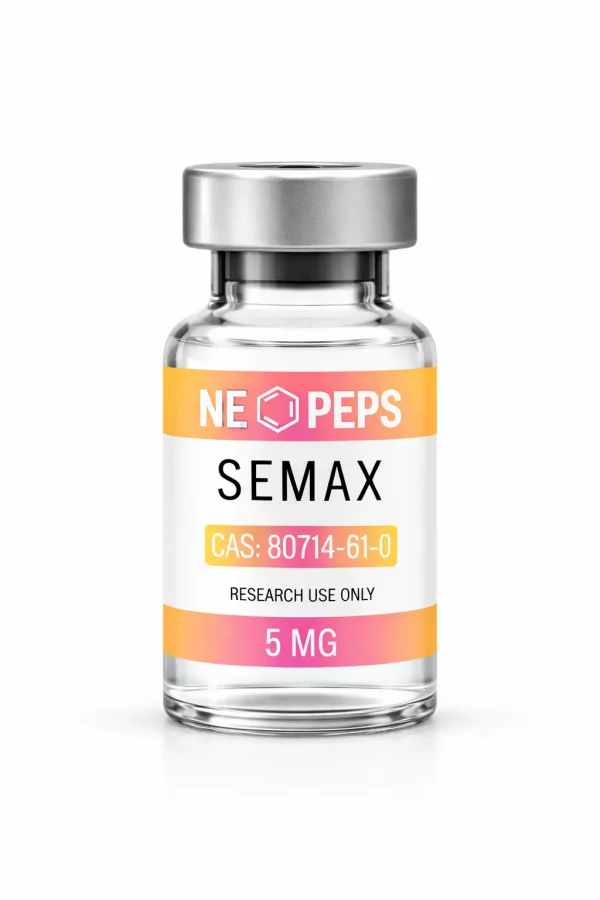
Semax is a synthetic heptapeptide based on a fragment of the hormone ACTH, extended with the sequence Pro-Gly-Pro. It has no hormonal effect on the adrenal glands but acts in the brain, where it increases the neurotrophic factors BDNF and NGF. It is studied in research on neuroprotection, cognition and neurotrophin signaling.
Requires reconstitution with bacteriostatic water prior to use.
Independently testedEvery batch analyzed by Janoshik
Fast shippingDispatched within 24h, EU-wide
30-Day Guarantee
If your order arrives damaged, gets lost, or a delivery issue occurs, we will replace it free of charge within 30 days of delivery.
The guarantee covers shipping and the condition of your order — it does not cover the effects or research outcomes of a compound.
Certificate of Analysis
Certificates are currently being renewed!
This product is currently undergoing a new round of independent third-party testing.
Updated Certificates of Analysis will be published here shortly after testing has been completed.
Semax is a synthetic heptapeptide based on a fragment of the hormone ACTH, extended with the sequence Pro-Gly-Pro. It has no hormonal effect on the adrenal glands but acts in the brain, where it increases the neurotrophic factors BDNF and NGF. It is studied in research on neuroprotection, cognition and neurotrophin signaling.
By raising BDNF and NGF and activating their receptors, Semax supports the survival and plasticity of neurons, the mechanism thought to underlie its effects in ischemia models.
Research background
In a rat model of stroke, Semax reduced the damaged brain area and normalized the expression of proteins involved in inflammation and neuronal survival (Int J Mol Sci 2021).
In rat brain, Semax rapidly increased the expression of the neurotrophin genes BDNF and NGF and their receptors (Agapova et al., Neurosci Lett 2007).
After reversible brain ischemia in rats, Semax suppressed the transcripts of pro-inflammatory mediators induced by the injury (Dergunova et al., Mol Biol 2021).
Research areas
Neuroprotection and ischemia models
Neurotrophin signaling (BDNF, NGF)
Cognition and attention
Research Use Only. This product is intended exclusively for in vitro and laboratory research. It is not approved for human or veterinary use and no therapeutic claims are made. Handle with appropriate laboratory precautions.






 Independently testedEvery batch analyzed by Janoshik
 Fast shippingDispatched within 24h, EU-wide