




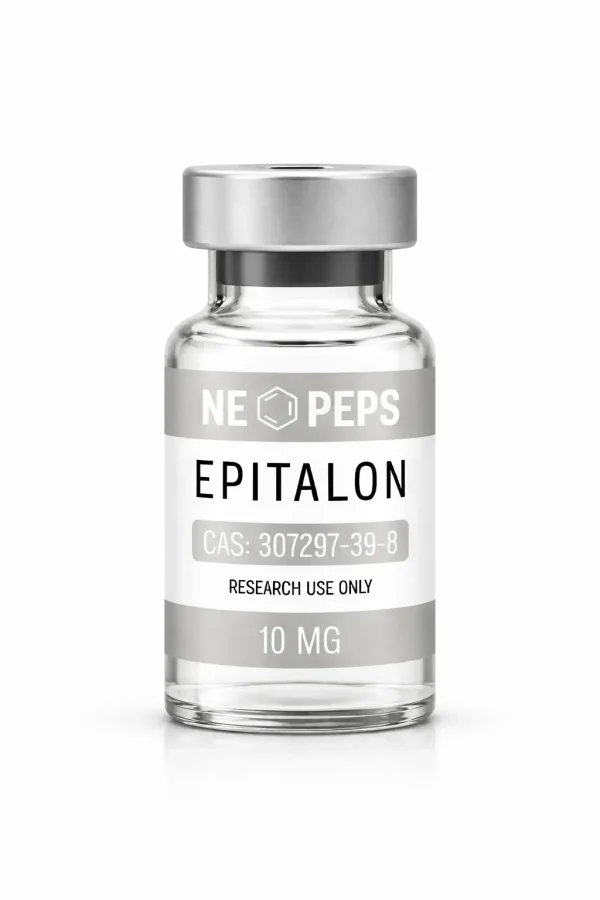
EPITALON | 10 MG
EPITALON | 10 MG
35,00 €
Epitalon is a synthetic tetrapeptide (Ala-Glu-Asp-Gly) modeled on epithalamin, an extract of the pineal gland. It was developed at the St Petersburg Institute of Bioregulation and Gerontology and is studied in animal and cell models for its effects on telomeres, melatonin production and biomarkers of aging.
Available Arrives between Nov 12 – Nov 16
 Independently testedEvery batch analyzed by Janoshik
 Fast shippingDispatched within 24h, EU-wide
Composition
Molecular profile.
Research
Published studies.
Effect of Epitalon on biomarkers of aging, life span and spontaneous tumor incidence in female Swiss-derived SHR mice PubMed ↗ Epithalon peptide induces telomerase activity and telomere elongation in human somatic cells PubMed ↗ Peptide promotes overcoming of the division limit in human somatic cell PubMed ↗Storage
Handling & stability.
Lyophilized
Reconstituted
About this compound.
Epitalon is a synthetic tetrapeptide (Ala-Glu-Asp-Gly) modeled on epithalamin, an extract of the pineal gland. It was developed at the St Petersburg Institute of Bioregulation and Gerontology and is studied in animal and cell models for its effects on telomeres, melatonin production and biomarkers of aging.
In cell culture the peptide activated telomerase, the enzyme that rebuilds the protective ends of chromosomes, which shorten with every cell division.
Research background
- In aging mice, Epitalon slowed several biomarkers of aging, reduced the incidence of spontaneous tumors and increased maximum lifespan (Anisimov et al., Biogerontology 2003).
- In cultured human somatic cells, Epitalon induced telomerase activity and lengthened telomeres (Khavinson et al., Bull Exp Biol Med 2003).
- Treated human cell cultures continued to divide beyond the usual Hayflick limit while keeping a normal karyotype (Khavinson et al., Bull Exp Biol Med 2004).
Research areas
- Telomere biology and cellular senescence
- Pineal function and melatonin rhythm
- Biomarkers of aging in animal models
Research Use Only. This product is intended exclusively for in vitro and laboratory research. It is not approved for human or veterinary use and no therapeutic claims are made. Handle with appropriate laboratory precautions.
Related products
-
CJC-1295
Price range: 35,00 € through 55,00 €Select options This product has multiple variants. The options may be chosen on the product page -
SELANK
Price range: 25,00 € through 40,00 €Select options This product has multiple variants. The options may be chosen on the product page -
MOTS-C | 10 MG
40,00 € -
MT 2 | 10 MG
30,00 €